
Top 10 Powder Sieve Machine Manufacturers Worldwide

Choosing a Powder Sieve Machine is not simply a matter of comparing prices or advertised capacity. The right equipment must suit the powder, production rate, and cleaning routine. Fine particles may need gentle screening, while heavier materials can demand greater throughput. Mesh size matters. So does the screen’s usable area. A compact unit might fit a crowded production room but struggle during continuous operation. Small details count.

This guide introduces ten manufacturers with international reach and examines what buyers can verify: machine configurations, screening methods, material options, technical support, and published performance data. It also considers practical features, such as tool-free screen changes, access for cleaning, vibration control, and footprint. These details affect daily use, not just the specification sheet. A manufacturer’s claims should be checked against a sample trial and the actual powder whenever possible. That step may take time, but it can reveal blinding, inconsistent separation, or an awkward cleaning process before installation.

There is no universal winner. A supplier suited to a high-volume plant may not fit a small workshop or a product that requires frequent changeovers. Rankings can also shift with region, application, and service availability. This comparison is a starting point, not a substitute for technical review. Buyers should confirm capacity under their own operating conditions and ask clear questions about maintenance and spare parts. A careful shortlist helps; assumptions do not.
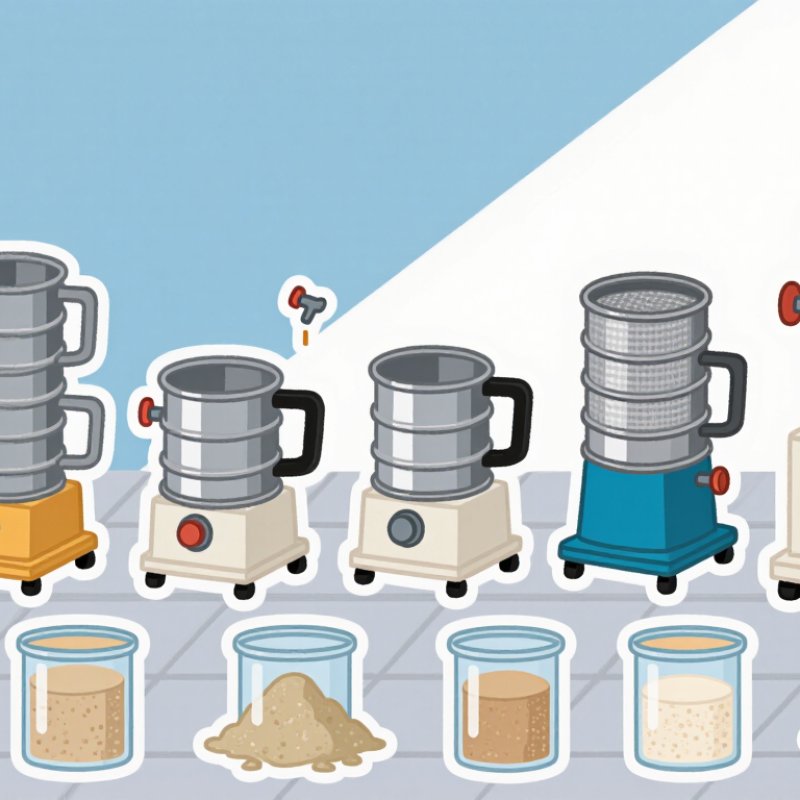
Top 10 Powder Sieve Machine Manufacturers Worldwide

Powder Sieve Machines: Working Principles and Main Components

Powder Sieve Machines: Working Principles and Main Components

A powder sieve machine separates particles by size as material passes across a mesh. In a vibrating model, a motor and eccentric weight create controlled motion. The particles travel over the screen; smaller ones pass through its openings, while larger ones move toward the outlet. Main components include the feed inlet, screen deck, drive unit, frame, discharge outlets, and dust cover. In rotary models, a turning screen performs the separation. The operating principle is simple, but feed rate and moisture can change performance.

Mesh selection sets the practical cut size. ASTM E11’s test-sieve specifications include nominal openings of 150 micrometres for No. 100 and 75 micrometres for No. 200 sieves. These figures help define a test reference; they do not guarantee identical production results. Screen tension, vibration amplitude, and particle shape also matter. A damp powder may cling to the mesh. That detail is easy to overlook.

Tips: Check the screen for tears before each run, and record the mesh size and feed rate. Compare samples from the inlet and outlet. If results drift, inspect buildup and vibration settings before changing the mesh. Operators sometimes trust the display too much. Physical checks still count.

Key Selection Metrics: Mesh Size, Throughput, and Separation Accuracy

Top 10 Powder Sieve Machine Manufacturers Worldwide: Key Selection Metrics

Choosing a powder sieve machine starts with the material, not the brochure. Match mesh size to the target particle range, then check whether the screen can separate particles without excessive blinding. Fine powders may need gentler vibration, while damp or irregular particles can behave differently than expected. Small details matter. Ask manufacturers for test results using a sample of your own product, not only standard reference powder.

Tips: Confirm the stated mesh opening and screen material. Compare throughput under your actual feed rate and moisture conditions. Test it first. Record the feed rate, particle distribution, and rejected fraction during each trial.

Throughput figures are useful only when test conditions are clear. A machine rated for high capacity may lose accuracy when overloaded, especially if particles have varied shapes or cling to the mesh. Ask how separation accuracy is measured and whether results include repeat trials. Check cleaning access, screen-change time, and vibration adjustment too; these affect daily performance. I would not treat one successful sample run as proof. A second test, with a slightly different feed condition, often reveals limitations that a polished demonstration misses.

ISO 3310-1 Test Sieves: Nominal Apertures from 20 μm to 125 mm

Top 10 Powder Sieve Machine Manufacturers Worldwide
ISO 3310-1 Test Sieves: Nominal Apertures from 20 μm to 125 mm

ISO 3310-1 test sieves cover nominal apertures from 20 μm to 125 mm, supporting checks across fine powders and coarse particles. Aperture size alone does not determine performance. Wire diameter, opening tolerances, frame condition, and cleanliness also matter. Fine mesh can blind quickly when powder is damp or electrostatic. A 125 mm opening handles a very different feed and needs suitable equipment. Keep that distinction in view.

Tips: Match the sieve stack to the target size range. Check each sieve’s identification and condition, and use consistent sample mass and shaking time. Brush gently; damaged wires can distort results.

When comparing powder sieve machines, ask how each unit controls motion, loading, and test duration across different sieve sizes. Confirm that the holder fits the selected frame and that operation does not cause excessive vibration or sample loss. Record the aperture series and test conditions. Repeatability is not automatic. Worn mesh, overloaded sieves, and inconsistent sampling can all affect results. Very fine powders may cling to surfaces, so handling needs attention. A single test may not tell the whole story.

Top 10 Powder Sieve Machine Manufacturers Worldwide: Products and Markets

A useful comparison of the top 10 powder sieve machine manufacturers starts with product capability, not headline capacity. Their ranges commonly include vibratory sifters, centrifugal screeners, and multi-deck units for food, pharmaceutical, chemical, and mineral powders. Buyers should check mesh options, contact-part materials, cleaning access, and whether a machine can maintain throughput with their actual powder. Fine flour may flow easily; a damp, cohesive blend may not. Small details matter.

Market demand gives this equipment wider context. Grand View Research valued the global food processing equipment market at USD 52.87 billion in 2023 and projected a 6.1% compound annual growth rate from 2024 to 2030. This points to continuing investment in production lines where consistent particle size supports quality control. Allied Market Research reported that the powder metallurgy market was valued at USD 2.9 billion in 2020, with a forecast of USD 4.5 billion by 2030. That market also needs controlled powder handling, though its requirements differ from food processing. Reports do not measure sieve-machine sales directly. This comparison is imperfect. For a practical shortlist, assess product range, target markets, test support, and documented performance with your own material—not just catalog specifications.

Powder Sieve Machines: Common Screen Apertures

Standard test-sieve openings illustrate the particle-size ranges that powder screening equipment can help separate.

Values show nominal sieve openings based on ASTM E11 standard sizes. Higher mesh numbers have smaller openings; the appropriate screen depends on the powder, target particle size, and process requirements.

Comparing Manufacturers by Capacity, Sieve Design, and Industry Applications

A useful comparison of powder sieve machine manufacturers starts with verified capacity, not headline throughput. Ask whether the quoted rate applies to your material, screen size, and moisture level. A dry, free-flowing mineral powder behaves differently from a fine food ingredient that clumps. The USGS Mineral Commodity Summaries 2024 estimated U.S. industrial sand and gravel output at about 120 million metric tons in 2023, illustrating the scale of bulk mineral handling. That figure is not a sieve-machine benchmark, but it shows why continuous-duty capacity matters in mineral applications.

Sieve design shapes both separation quality and maintenance. Compare circular and linear motion, deck count, screen tensioning, changeover time, and dust containment. ASTM E11 defines test-sieve openings such as 150 and 75 micrometers, useful reference points when discussing cut sizes; production results still depend on feed properties and operating conditions. Food, chemical, and mineral processors should request trials using representative samples. Ask for measured throughput, oversize carryover, and screen life. A neat specification sheet is not enough.

Tips: Match the machine’s contact materials and cleaning access to the application. Check how quickly operators can replace a blinded screen. Small details matter. Compare capacity at the required separation quality, not maximum feed rate alone. I would also question unusually precise performance claims unless the test method and powder conditions are disclosed.

Top 10 Powder Sieve Machine Manufacturers Worldwide — Comparing Capacity, Sieve Design, and Industry Applications
Profile Common Sieve Design Indicative Throughput Range Typical Sieve / Screen Arrangement Suitable Materials Common Industry Applications Key Selection Consideration
Manufacturer Profile 01 Round vibratory separator About 0.1–5 t/h One or more circular decks; interchangeable woven-wire or perforated screens Free-flowing powders, granules, and pellets Food processing, chemicals, minerals, and plastics Capacity depends strongly on screen opening, product loading, and the number of decks.
Manufacturer Profile 02 Ultrasonic-assisted vibratory sieve About 0.05–2 t/h Fine mesh with an ultrasonic transducer and screen-cleaning system Fine, cohesive, or electrostatically charged powders Pharmaceuticals, additives, pigments, and fine chemicals Useful for reducing mesh blinding; confirm the required particle-size cut and cleaning method.
Manufacturer Profile 03 Gyratory sieve separator About 0.5–20 t/h Large horizontal decks with a controlled gyratory screening motion Bulk powders and granules requiring high-volume classification Mining, fertilizers, grain processing, and bulk chemicals Requires adequate floor space; actual throughput varies with bulk density and screen area.
Manufacturer Profile 04 Linear vibrating screen About 0.5–30 t/h Rectangular deck with linear vibration; single- or multi-deck configurations Dry, relatively free-flowing powders and granular materials Minerals, construction materials, chemicals, and recycling Best suited to steady feed and defined separation cuts; check screen loading and installation space.
Manufacturer Profile 05 Centrifugal rotary sifter About 0.1–10 t/h Rotating internal paddle or impeller passes material through a cylindrical screen Dry powders, flour-like products, and materials prone to soft agglomeration Food, feed, chemicals, and plastics Consider heat sensitivity, particle fragility, and the suitability of the rotor speed for the product.
Manufacturer Profile 06 Inline safety sifter About 0.1–5 t/h Compact vibratory screen installed in a gravity or conveying line Dry bulk solids needing a final oversize check Food ingredients, powders, polymers, and chemical processing Check connection size, line flow rate, and access for screen inspection and cleaning.
Manufacturer Profile 07 High-capacity multi-deck screening system About 2–30 t/h Multiple large-area decks for simultaneous size classification Granules and bulk solids processed at high production rates Mining, minerals, fertilizer, and large-scale chemical plants Screen area, feed distribution, and maintenance access are critical at higher capacities.
Manufacturer Profile 08 Tumbler screening machine About 0.2–20 t/h Gentle, multi-plane circular motion with one or more stacked screen decks Fragile, spherical, or difficult-to-screen dry materials Food, pharmaceuticals, abrasives, and specialty chemicals Offers gentle screening and large effective screen area; assess footprint and screen-change time.
Manufacturer Profile 09 Vacuum-conveying sieve station About 0.05–3 t/h Enclosed sieve integrated with vacuum transfer and a sealed product path Fine powders requiring contained transfer and screening Pharmaceuticals, food, battery materials, and specialty chemicals Confirm containment level, filter arrangement, cleaning procedure, and conveying requirements.
Manufacturer Profile 10 Laboratory test sieve shaker About 1–100 kg/h Stacked test sieves with controlled mechanical or electromagnetic agitation Small samples for particle-size analysis and quality control Research laboratories, quality assurance, minerals, and pharmaceuticals Designed for testing rather than production; select sieve standards and sample size to match the method.

Note: Company names are intentionally omitted. The profiles compare common commercial machine configurations rather than identify or rank specific manufacturers. Throughput figures are broad indicative ranges, not verified claims for individual suppliers; actual capacity depends on material properties, screen aperture and area, moisture, feed rate, and the required separation efficiency.