
What Are the Top Goods Lift Manufacturers in China?
China’s Goods Lift market includes manufacturers serving factories, warehouses, retail sites, and construction projects. Their products can look similar in a catalogue, yet differ in rated load, travel height, platform size, and control options. A small loading bay may need a compact platform and a simple door arrangement. A busy warehouse may require frequent cycles and easier maintenance access. The details matter.
Lift pioneer Elisha Otis is famously credited with saying, “All safe, gentlemen, all safe!” Safety remains central, but buyers should also examine how a manufacturer supports a lift after installation. This guide compares leading Goods Lift manufacturers in China through practical criteria: product range, engineering capability, customization, quality documentation, service coverage, and export experience. No single brand is right for every site. A low purchase price, for example, may not reflect installation needs or future maintenance costs. A cautious comparison helps.
The ranking should be treated as a starting point, not a substitute for technical review. Ask suppliers for current specifications, load calculations, installation requirements, and references for comparable projects. Check that the proposed lift fits the building’s available shaft or installation space. Confirm who handles commissioning, spare parts, and service response. Small omissions can become expensive. This overview aims to help buyers identify credible manufacturers and ask sharper questions before requesting quotations. It also leaves room for a hard truth: published claims are not the same as verified performance.
Understanding Goods Lifts and Their Industrial Applications
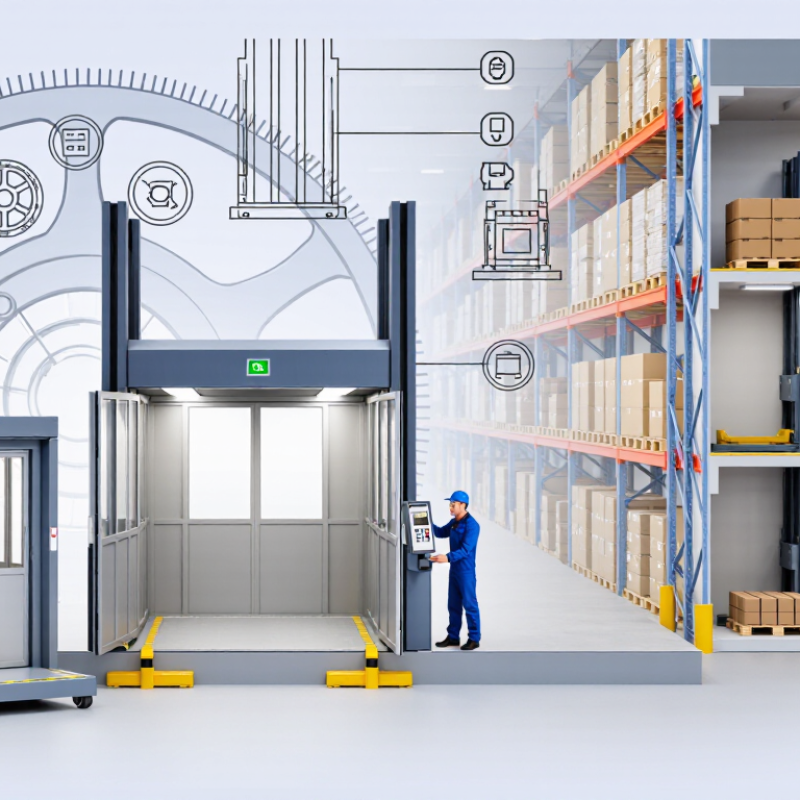
Goods lifts move pallets, components, and tools between levels without relying on forklifts at every landing. In a factory, that can mean sending a 900-kilogram parts cage from a loading bay to a mezzanine, then keeping production aisles clear. The right lift depends on payload, platform size, travel height, loading method, and cycles per hour. A machine serving occasional deliveries has different needs from one feeding a busy assembly line.
Automation makes this vertical link more important. The International Federation of Robotics’ World Robotics 2024 report recorded 541,302 industrial robots installed worldwide in 2023. Robots do not prove demand for goods lifts, but automated production still needs dependable movement between floors. MHI’s 2024 Annual Industry Report found that 55% of surveyed supply-chain professionals planned to increase technology investment. Lift controls should therefore be assessed alongside conveyors, warehouse systems, and safety interlocks—not in isolation.
A practical specification starts with real loads and traffic patterns, not the largest capacity on a brochure. Measure the tallest pallet, check door clearances, and note whether operators use hand pallet trucks. Landing gates, overload protection, and clear fault indicators matter during daily use. Local requirements vary, so qualified engineers should verify the design and installation. One detail is easy to miss: peak-hour queues can erase the time a lift was meant to save. My own first estimate would still need testing against a week of actual shift data.

How China’s Goods Lift Manufacturing Industry Is Structured
China’s goods-lift sector is not one uniform factory network. It combines full-system manufacturers, specialist component suppliers, and regional assemblers. Full-system firms typically coordinate hoists, guide rails, doors, controls, and safety devices. Smaller suppliers may focus on motors, landing doors, or steel structures. This division lets manufacturers adapt platforms and cabins to warehouses, workshops, and loading bays. The seams matter.
The National Bureau of Statistics reported about 1.55 million elevators and escalators produced in China in 2023. That figure covers the wider product category, not goods lifts alone, so it should not be read as a goods-lift market count. China Elevator Association industry reporting also tracks exports and installed equipment, but public totals rarely separate freight models clearly. The picture is not perfectly clean.
Buyers comparing factories should therefore check what each supplier actually makes in-house, then review load testing, door interlocks, maintenance access, and documented quality controls. A polished catalogue tells only part of the story. A lift’s practical design is easier to judge from drawings, inspection records, and a sample installation.
Criteria for Identifying Leading Goods Lift Manufacturers
What Are the Top Goods Lift Manufacturers in China?
Criteria for Identifying Leading Goods Lift Manufacturers
Choosing a goods lift manufacturer in China requires more than comparing prices. Look for evidence of engineering capability. Ask for rated-load calculations, platform dimensions, travel height, and duty-cycle details. The lift design should match your building and the goods you move. A supplier should explain how guides, brakes, doors, and overload protection work together. Request test records for the proposed configuration, not just a generic brochure. Specific answers matter.
Check factory quality controls, including incoming-part inspection, weld checks, electrical testing, and final load testing. Ask who installs the lift and how technicians are trained. Review spare-part availability, response times, manuals, and maintenance schedules in writing. References from projects with similar loads and operating conditions can reveal practical strengths. Still, a polished showroom is not proof. Some details are easy to miss during a short visit.
Tips: Bring a simple site plan and list your heaviest items. Ask the manufacturer to describe one realistic operating cycle, including a power interruption or door fault. Note any vague answers. No checklist is perfect.
What Are the Top Goods Lift Manufacturers in China?
Standards-based criteria for identifying leading goods lift manufacturers
Use relevant standards as evidence checkpoints when assessing quality management, workplace safety, and machinery risk assessment. The bars show the publication years of the listed editions—not manufacturer rankings or proof of product compliance. Verify each standard’s current edition and the scope of any claimed certification.
Notable Chinese Manufacturers and Their Product Strengths
Chinese goods-lift manufacturers range from large elevator producers with dedicated freight lines to regional engineering firms that build to site specifications. Their strengths often include high-capacity traction lifts for warehouses, hydraulic models for shorter travel, and compact platforms for workshops. China’s State Administration for Market Regulation reported about 10.16 million elevators in service at the end of 2023. That installed base supports a broad maintenance and parts network, though it does not measure goods lifts alone.
Look beyond rated load. A 2,000-kilogram lift may still be a poor fit if its platform cannot take a standard pallet or its doors obstruct a forklift route. Ask manufacturers for drawings, duty-cycle ratings, safety-device details, and service response times. The China Elevator Association’s annual industry reporting helps show the scale of the domestic sector, but buyers should compare individual models against their actual site conditions. Check carefully. Some product sheets give load capacity more space than operating limits. That deserves a second look. Strong suppliers make the trade-offs visible, including pit depth, headroom, loading access, and maintenance intervals.
What Are the Top Goods Lift Manufacturers in China? - Notable Chinese Manufacturers and Their Product Strengths
The comparison below summarizes common product capabilities offered by Chinese goods-lift manufacturers without naming companies or brands. Actual load ratings, travel heights, speeds, and configurations depend on the model and project.
| Product capability | Typical drive or design | Common applications | Product strengths | Key points to verify |
|---|---|---|---|---|
| Traction freight elevators | Electric motor, ropes or belts, and a counterweight | Factories, warehouses, commercial buildings, and multi-storey facilities | Suitable for moving goods between multiple floors; available in a range of car sizes, capacities, and door arrangements | Rated load, car and door dimensions, travel height, speed, duty cycle, and applicable local code requirements |
| Hydraulic freight elevators | Hydraulic power unit and cylinder-driven lifting system | Low- to mid-rise industrial and commercial sites, subject to project design | Can suit heavy-load applications and some building layouts where a conventional overhead machine-room arrangement is impractical | Travel and speed limits for the selected design, pit and overhead requirements, hydraulic equipment location, and maintenance access |
| Vertical platform and scissor goods lifts | Platform lifted by a hydraulic scissor mechanism or another guided lifting arrangement | Loading areas, workshops, mezzanines, and material-transfer points | Provides a direct way to raise goods between defined levels; platform size and access layout can be tailored to the installation | Whether the equipment is intended for goods only, guarding and interlocks, rated load, platform travel, and applicable machinery or lift regulations |
| Industrial dumbwaiters | Compact guided car with an electric lifting system | Restaurants, laboratories, clinics, and facilities moving small items between floors | Small footprint and convenient transfer of packaged goods, dishes, samples, or supplies | Car dimensions, rated load, serving height, door interlocks, hygiene requirements, and whether people are prohibited from riding |
| Customized goods-lift systems | Drive system and controls selected for the building and handling process | Production lines, distribution facilities, and sites with unusual goods or access requirements | Can be configured around goods dimensions, loading methods, floor openings, and integration with site operations | Written design specifications, drawings, safety devices, installation scope, commissioning tests, warranty, and local approvals |
Buyer note: Compare manufacturers using project-specific technical proposals and applicable certifications. Do not treat product-category descriptions as guaranteed specifications; confirm every rating and compliance claim for the exact model and installation.
How to Compare Manufacturers for a Specific Project
Comparing goods lift manufacturers for a specific project starts with the actual job, not a brochure. Record the heaviest load, platform size, travel height, number of stops, and expected trips per hour. Include awkward items, too: a long crate may need more platform space than its weight suggests. Ask each manufacturer to confirm that the proposed capacity suits your duty cycle, not just the maximum load.
Check how each supplier handles site details. Door openings, shaft dimensions, floor conditions, power supply, and loading arrangements can change the design. Request drawings, installation requirements, safety features, maintenance intervals, and a clear breakdown of what the quotation excludes. Compare delivery and commissioning plans, too. A low price may leave important work outside the scope. A polished proposal can still miss a site constraint; it happens.
Tips: Send every manufacturer the same project brief, then compare their answers line by line. Ask for references from installations with similar loads and travel heights. Clarify who provides after-sales support and how quickly service is typically available. If an answer feels vague, ask for a drawing or written specification. Trust, but verify.

