What Are the Top Types of Corrugated Steel Pipe in 2026?
Corrugated Steel Pipe remains a practical choice for culverts, stormwater systems, and site drainage. Its corrugated walls provide strength while keeping the structure relatively lightweight. But “top” does not mean one shape suits every project. Soil conditions, water flow, available cover, and installation access all affect the right choice.
This guide examines common options for 2026, including round pipe, pipe-arch, arch, structural plate, and perforated drainage pipe. Each serves different needs. Round pipe is familiar and often straightforward to install, while pipe-arch can provide a wider opening where vertical clearance is limited. Structural plate sections can accommodate larger spans, though assembly and site conditions deserve careful review. Small details matter. A coating choice, for example, should reflect the soil and water exposure expected at the site.
That sounds tidy. Real sites are messier. A product’s suitability depends on project-specific design, manufacturer specifications, and applicable engineering requirements, not just a category name. Comparing hydraulic capacity, load demands, corrosion protection, and installation requirements can help narrow the options. This overview is a starting point, not a substitute for professional design review. Even a well-known pipe type may be the wrong fit when drainage patterns or ground conditions differ. The best choice is the one supported by reliable project data and a clear understanding of what the site will demand.
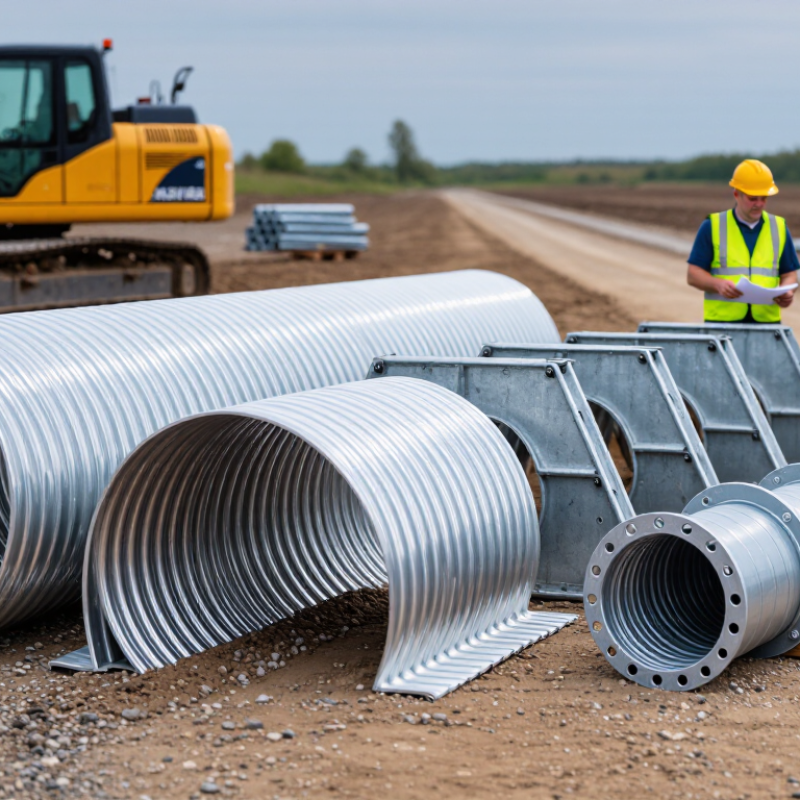
Classify Corrugated Steel Pipe Under ASTM A760 and AASHTO M36
What Are the Top Types of Corrugated Steel Pipe in 2026?
Classify Corrugated Steel Pipe Under ASTM A760 and AASHTO M36
ASTM A760 and AASHTO M36 are specifications, not rankings of the “best” pipe types. They set requirements for metallic-coated corrugated steel pipe, including materials, dimensions, workmanship, and testing. In practice, classify products by shape and construction: round pipe and pipe-arch are common options, while corrugation profile and seam style also affect selection. Structural plate products may fall under separate specifications, so verify the governing standard on project documents.
Shape matters. Round pipe can suit constrained sites, while pipe-arch provides a wider opening with less vertical clearance. Corrugation affects flow, too. FHWA’s Hydraulic Design of Highway Culverts reports a Manning roughness value near 0.024 for pipe with 2⅔-by-½-inch corrugations. That figure is a design input, not a guaranteed field result; sediment and installation can change performance. Small details count.
Tips: Check the standard edition, coating callout, diameter, corrugation dimensions, and end treatment against the drawings. Don’t rely on a type label alone. Confirm hydraulic needs and site conditions with the project engineer. I’ve seen schedules leave end details vague; that is easy to overlook, but it can complicate installation.
Compare Helical-Seam and Annular-Ring Profiles by Corrugation Geometry
Helical-seam and annular-ring pipes differ in how their corrugations travel across the steel shell. In a helical-seam profile, the corrugation follows a continuous spiral around the pipe. Its seam also runs along that spiral path. In an annular-ring profile, corrugations circle the pipe at right angles to its length, like stacked ridges. Geometry matters. The distinction sounds simple, but drawings can make it less obvious.
These profiles can suit different manufacturing methods and project requirements; neither is automatically the better choice. Helical corrugations may support continuous production, while annular rings create distinct circumferential ribs. Actual performance depends on factors such as diameter, wall thickness, soil cover, loading, and installation. Check project specifications rather than choosing by profile name alone. A small mismatch in corrugation dimensions can matter.
Tips: Compare corrugation depth, pitch, and seam details on the supplier’s drawings. Confirm that the proposed profile matches the project’s structural design and drainage needs. Ask how the pipe ends connect to adjoining sections, since joint details affect alignment in the field. Measure carefully. If the drawings omit a dimension, request clarification before ordering.
Top Corrugated Steel Pipe Profiles in 2026: Helical-Seam vs. Annular-Ring
A geometry-based comparison of two common corrugated pipe profiles.
The chart uses a simple geometry key: 1 means the feature is characteristic of the profile; 0 means it is not. Annular corrugations form circumferential rings, while helical corrugations follow a spiral path that advances along the pipe. These are geometry descriptors, not dimensional or performance ratings; helix angle and pitch vary by design.
Assess Galvanized CSP Against AASHTO M36’s 610 g/m² Zinc Benchmark
Among the main corrugated steel pipe options in 2026 are galvanized, aluminum-coated, polymer-coated, and structural-plate systems. Galvanized CSP remains widely specified because its zinc layer offers practical corrosion protection and is easy to inspect.
AASHTO M36-21 sets a minimum zinc coating mass of 2 oz/ft², or about 610 g/m². That figure is a measurable procurement benchmark, not a service-life promise. Not a lifespan guarantee.
For reliable quality control, compare mill certificates with the project specification and confirm coating mass using an accepted test method. Also inspect handling damage, cut ends, and corrugation valleys, where thin or disturbed coating can be overlooked.
FHWA’s Culvert Repair Practices Manual (FHWA-RD-94-096) discusses corrosion and abrasion as condition-dependent factors in culvert assessment. That matters because soil resistivity, water chemistry, and sediment movement can change exposure substantially.
A pipe meeting 610 g/m² may still need a different protective system in a harsh site. The benchmark helps; it does not replace site data. And field checks are not always perfect.
Compare Aluminum-Coated and Polymer-Lined Pipes for Corrosive Soils
Corrugated steel pipe selection in 2026 still depends on where corrosion starts. Aluminum-coated pipe places a metallic layer between steel and its environment. It can suit many drainage applications, but performance depends on soil chemistry, moisture, and coating damage.
Check pH, resistivity, and evidence of stray water paths before specifying it. Small scratches matter.
Polymer-lined pipe uses a bonded plastic layer to shield the surface it covers. Here is the catch: an internal lining protects against corrosive water inside the pipe, not aggressive soil outside it.
For corrosive soils, confirm whether the design includes exterior protection or full encapsulation. Joints and cut ends deserve close attention; they can expose steel even when the main surface is covered. Not always obvious.
On site, look for abrasion risks, sharp bedding material, and standing water near the pipe. I would avoid choosing by coating name alone. Soil tests and the expected flow tell a more reliable story, though field conditions can still surprise you.
Select Structural-Plate CSP by Span, Load, and Installation Method
Structural-plate CSP suits crossings where a standard pipe diameter cannot provide enough opening. Match the clear span to the required waterway and expected soil cover, not just the ditch width. A common structural-plate corrugation profile is 6 by 2 inches, specified in AASHTO M 167. The deep corrugations help the assembled shell interact with surrounding soil. But they do not replace a project-specific structural check.
Loads change the selection. Highway traffic, construction equipment, fill depth, and soil conditions all affect plate thickness and ring strength. AASHTO’s LRFD Bridge Design Specifications provide the framework for evaluating these effects; ASTM A761/A761M covers structural-plate material requirements. FHWA’s Hydraulic Design of Highway Culverts, HDS-5, also emphasizes checking design flow, headwater, and outlet conditions. A pipe that carries the design flow may still create unwanted upstream ponding. Check both.
Installation method matters just as much. Field-bolted plates arrive in manageable sections, then form a pipe, pipe-arch, or arch on site. This can help where a long, heavy unit cannot reach the crossing. Yet assembly quality is critical. Uneven bedding, loose bolts, or poorly compacted backfill can distort the shape. A spreadsheet can miss those site details. Review span, cover, load, soil, and erection sequence together before choosing the section.