How to Choose a U240B Suspension Glass Insulator in 2026?
Choosing a U240b Suspension Glass Isolator in 2026 means matching the insulator to the line, not choosing by product code alone. Grid expansion is increasing pressure on transmission equipment. The International Energy Agency’s 2023 report, Electricity Grids and Secure Energy Transitions, says annual grid investment needs to rise to more than US$600 billion by 2030. That figure describes the wider grid challenge; it does not specify demand for any particular insulator. Still, it makes careful procurement and dependable performance more important.
Start with the actual operating conditions. Confirm the system voltage, required mechanical load, pollution severity, altitude, and environmental exposure against the project specification. Check the manufacturer’s drawings, test certificates, and traceable quality records. IEC 60305 and IEC 60383-1 provide relevant references for cap-and-pin insulator characteristics and testing, but project requirements and applicable editions must also be verified. Do not assume that “U240B” alone confirms dimensions, strength, or interchangeability. Small differences matter.
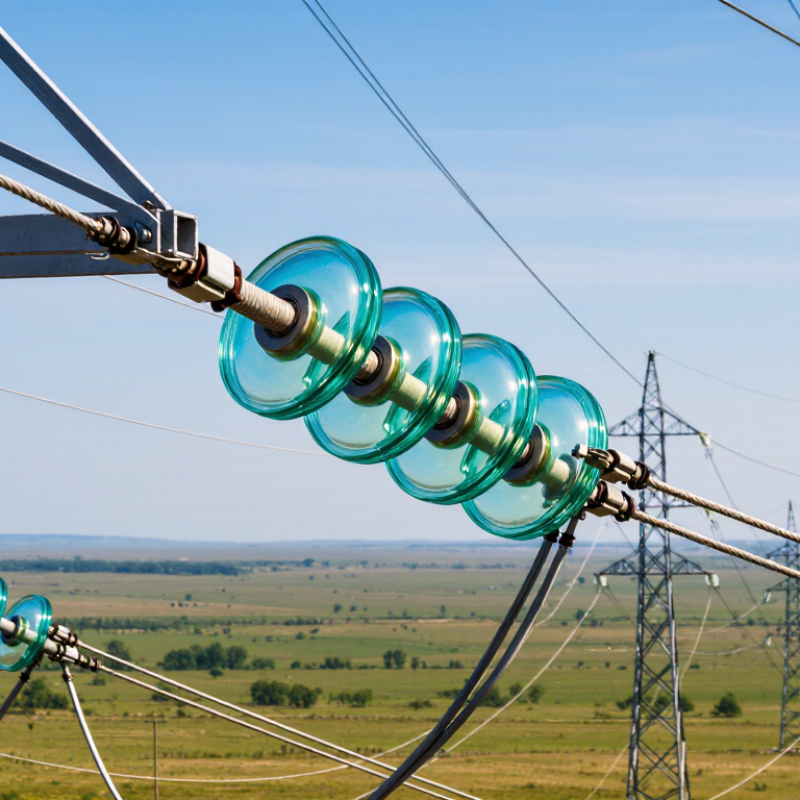
Glass offers a useful visual advantage: damage can often be easier to spot during inspection. Yet that is not a substitute for engineering review or field checks. Compare the stated electromechanical rating, creepage distance, hardware fit, and documented test results. Ask suppliers to explain any mismatch between catalogue values and project needs. It may feel tedious. It is worth it. A careful choice balances standards, site conditions, verified evidence, and maintenance practice. Even then, the final decision deserves a second look.
Decode the U240B Designation and Its 240 kN Mechanical Rating
The U240B designation gives a useful starting point when comparing suspension glass insulators. “U” generally identifies a cap-and-pin unit, while “240” refers to a specified mechanical failing load of 240 kN. The “B” indicates a coupling designation, but its exact dimensions should be checked against the applicable standard and product drawing. Do not treat 240 kN as the permitted everyday line load. It is a rating used under defined test conditions.
For selection, compare the insulator’s rating with the line design, including conductor tension, wind and ice loads, and the required safety factors. Check that the coupling fits the adjoining hardware; a small mismatch can complicate installation. Look closely at the glass surface, metal caps, and cemented joints for chips, corrosion, or uneven assembly. Small flaws matter.
In 2026, request current dimensional drawings, test documentation, and traceability records before approval. Confirm the specified creepage distance and electrical performance for the pollution and voltage conditions at the site. A higher mechanical rating alone does not guarantee a suitable unit. Field conditions can be messier than the design assumptions, so that deserves a second look.
Match the 240 kN Rating to Line Loads and Required Safety Factors
How to Choose a U240B Suspension Glass Insulator in 2026?
A U240B’s 240 kN rating describes its specified mechanical strength, not a routine working load. Compare it with the maximum calculated load on the string, including conductor tension, wind, ice, line angles, and installation conditions. Then apply the safety factor required by the project’s design criteria. The calculation should use documented load cases, not a rough estimate.
Check the complete insulator string, fittings, and support structure; the weakest component can govern. Also confirm electrical requirements, such as creepage distance and insulation performance for local pollution and altitude. A spreadsheet can look precise while concealing a questionable assumption. Recheck inputs against site conditions and current technical specifications.
Small detail. Big consequence.
Tips: Ask for test documentation confirming the 240 kN rating and verify the exact unit configuration. Keep mechanical and electrical checks separate. If the calculated load or safety factor is uncertain, pause selection and have a qualified line engineer review it.
Select Creepage Distance Using Site Pollution Severity and IEC 60815
How to Choose a U240B Suspension Glass Insulator in 2026?
For a U240B glass insulator, choose creepage distance from measured site pollution, not the insulator code alone. IEC 60815-1 and IEC 60815-2 provide a framework for classifying pollution and selecting ceramic or glass insulators. Their reference unified specific creepage distances are 22, 27.8, 34.7, 43.3, and 53.7 mm/kV, spanning very light to very heavy pollution. These values are screening benchmarks, not a substitute for site assessment. Small details matter.
Record salt and dust deposition, fog frequency, rainfall, and nearby industrial activity. Where available, compare equivalent salt deposit density and non-soluble deposit measurements across seasons. IEC’s values are normalized against the highest voltage for equipment, Um; verify the voltage basis and applicable standard edition before sizing. Then check the insulator’s actual profile, spacing, altitude, and wetting conditions.
Not just salt.
A coastal site may look clean after rain yet accumulate salt during dry, windy weeks. I would not trust one survey alone. A conservative selection should reflect credible worst-season conditions, while avoiding an unexamined jump to the highest class.
Keep the survey dates, test methods, and assumptions with the engineering record.
Check Insulator Dimensions, Ball-and-Socket Fit, and Corrosion Protection
How to Choose a U240B Suspension Glass Insulator in 2026?
A U240B suspension glass insulator should match the specified electrical and mechanical requirements of the line. Check the product drawing for unit diameter, spacing, and creepage distance; do not rely on a type code alone. Confirm the rated mechanical load against the project specification. Small dimensional differences can affect string length and clearance. Measure carefully.
Tips: Compare the insulator’s ball-and-socket dimensions with the adjoining fittings. Check socket depth, ball diameter, and locking-pin position against the assembly drawing. A connection that looks close may still bind or loosen under movement. Fit matters. Where possible, verify a sample with the actual hardware before ordering a full string.
Corrosion protection deserves equal attention, especially near coastal sites or industrial emissions. Inspect metal end fittings for a consistent protective coating, smooth coverage, and unprotected edges around joints. Ask for coating details and inspection records, then compare them with the project’s requirements. Salt spray can reach small defects. Still, a coating specification cannot replace routine inspection; site conditions and handling can leave damage that paperwork will not show. Check the fittings again after transport and before installation.
Verify Type-Test and Routine-Test Records Against IEC 60305 and IEC 60383-1
When evaluating a U240B suspension glass insulator, treat test records as evidence, not decoration. Check that the type-test report identifies the same design, material, dimensions, and connection details as the offered unit. Confirm its stated load rating and configuration match the purchase specification.
Compare the reported methods and acceptance criteria with the applicable editions of IEC 60305 and IEC 60383-1. Type tests assess design performance; routine tests are performed on individual units during production. Keep those purposes distinct. Look for the test date, specimen identification, measured results, and clear links to the production drawing. A report without traceable details deserves follow-up.
For routine-test records, compare serial numbers or batch codes with the marking on the insulator and its shipping documents. Check that the stated checks and results meet the agreed specification, and ask for clarification where entries are missing or inconsistent. Small details matter. No certificate proves everything. A mismatch may be a clerical error, but it should not be assumed harmless. Request the manufacturer’s explanation and supporting records, and verify that the standards’ editions align with the contract. This review takes time, and even careful checks can miss something; an independent technical review may help with high-value orders.