China Best Overhead Crane Wire Rope Manufacturers
Choosing among China’s best overhead crane wire rope manufacturers requires more than comparing price or breaking-load figures. The rope must match the crane’s duty cycle, sheave diameter, drum configuration, and operating environment. A mismatch can show up as uneven winding, birdcaging, or broken outer wires. Small signs matter.
ISO 4309:2017 provides guidance for the care, inspection, and discard of steel wire ropes used on cranes. Its inspection approach makes rope condition—not a catalogue claim—the practical basis for replacement decisions. Buyers should ask manufacturers for traceable test records, rope construction details, lubrication specifications, and documented quality-control procedures. The CMAA’s crane specifications also help buyers assess equipment duty and operating conditions, though they do not replace rope-specific selection advice.
Market context matters, but it should be read carefully. Grand View Research’s global wire rope market report tracks demand across sectors such as construction and industrial lifting; its broad market figures do not, by themselves, verify a crane-rope supplier’s quality. That distinction is easy to miss. Manufacturer claims need evidence.
A direct quotation from a named overhead-crane wire-rope expert cannot be responsibly included without a verifiable source. Rather than invent one, this guide focuses on standards and supplier documentation. That is less dramatic, perhaps, but more useful when a rope must carry real loads, shift after shift.
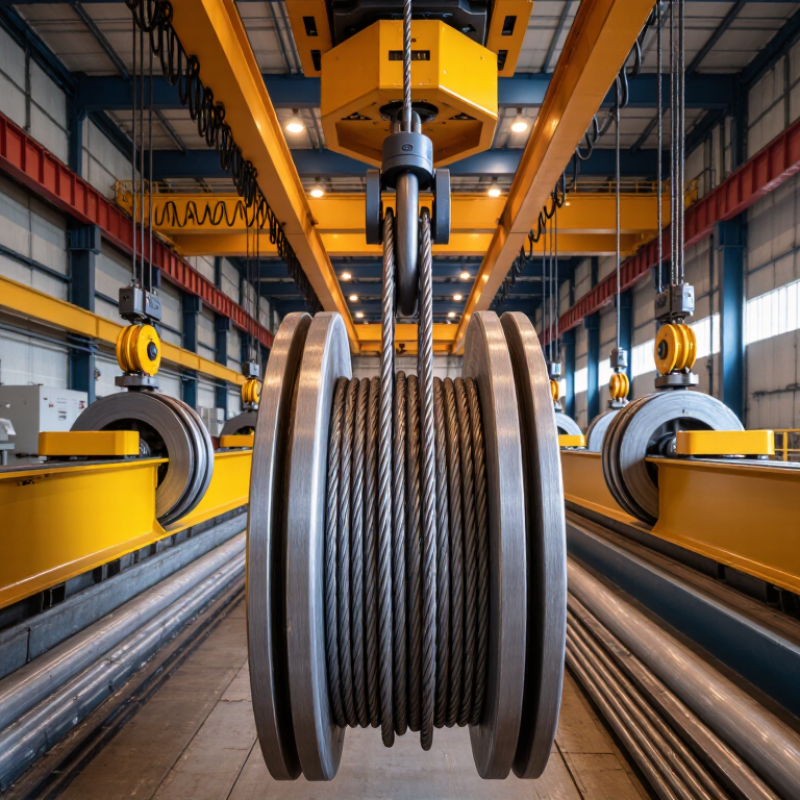
Overview of Overhead Crane Wire Rope Manufacturing in China
China’s overhead crane wire rope manufacturing combines material preparation, stranding, closing, lubrication, and inspection. Production usually begins with steel wire selected for strength and surface condition. Wires are drawn to controlled diameters, then twisted into strands around a core. Details matter. The core may be fiber or steel, depending on load, operating environment, and handling requirements.
During stranding, consistent wire tension helps keep the rope’s geometry stable. Closing equipment brings strands together with a specified lay, while lubrication reduces friction and helps limit corrosion. Manufacturers commonly check rope diameter, lay length, surface appearance, and lubrication coverage. Samples may undergo tensile or breaking-force tests. A test result matters, but it cannot replace routine process control.
Factories in China vary in equipment, production scale, and inspection practices, so buyers should review specifications rather than rely on broad claims. Ask for the rope construction, nominal diameter, core type, and documented test results. For crane service, the sheave diameter and operating pattern also matter. A rope that looks sound may still wear quickly if it does not match the equipment. Small inconsistencies can be easy to miss. That is why clear records and repeatable checks are worth examining before shipment.
Key Standards and Quality Factors for Crane Wire Ropes
For overhead cranes, wire-rope quality starts with a traceable specification, not a polished surface. ISO 2408:2017 sets requirements for steel wire ropes, including construction and minimum breaking force. ISO 4309:2017 addresses care, inspection, and discard criteria. These standards give buyers a practical basis for comparing ropes, while reminding them that one breaking-load figure cannot describe every service condition.
Check rope diameter, lay direction, core type, lubrication, and measured breaking force against the crane design. A test certificate should identify the rope construction and test results, so the delivered rope can be matched to the order. During inspection, record diameter changes, broken wires, corrosion, and crushing near sheaves or drums. Small flaws matter. ISO 4309’s discard assessment considers rope condition and construction; a single universal broken-wire limit is not reliable for every rope.
In supplier evaluations, ask for material traceability, production inspection records, and documented test methods. Also compare the rope’s flexibility and resistance to wear with the duty cycle, sheave diameter, and operating environment. A rope that performs well in a clean workshop may deteriorate faster around abrasive dust or persistent moisture. Paperwork can still miss handling damage, and visual checks are imperfect. Keep inspection records tied to the actual crane and rope, not just the purchase batch.
How to Evaluate Chinese Wire Rope Manufacturers
China Best Overhead Crane Wire Rope Manufacturers
How to Evaluate Chinese Wire Rope Manufacturers
Evaluating a Chinese wire rope manufacturer takes more than comparing prices or reading a polished catalogue. Ask for the rope’s construction, core type, nominal diameter, tensile grade, and breaking-force test results. Then check whether documents identify the production batch, not just a general product range. The World Steel Association’s World Steel in Figures 2025 reports 1,882.6 million tonnes of crude steel production worldwide in 2024, including 1,005.1 million tonnes in China. This shows the scale of the steel supply chain, not the quality of any individual rope. A large industrial base is no substitute for product-level evidence.
Request samples and inspect wire finish, strand consistency, and rope diameter at several points. Review test records for breaking force and ask how the manufacturer controls lubrication, lay length, and batch traceability. For overhead crane applications, compare the rope’s specifications with the equipment maker’s requirements and relevant inspection guidance, such as ISO 4309. Verify that certificates can be matched to the delivered batch. A tidy certificate alone is not enough. A polished brochure can still leave gaps, so clarify who performs testing and whether reports are independently verified. This detail is easy to overlook.
Tips: Ask for a recent batch test report before placing a large order. Confirm lead times, packaging, and sample availability in writing. Keep one sample for comparison after delivery. Good paperwork helps, but it cannot replace checking the actual rope.
Leading Manufacturer Profiles and Product Specialties
China’s overhead crane wire-rope manufacturers differ less by catalogue size than by engineering focus. Some specialize in compacted strands for high breaking force and smoother sheave travel; others make rotation-resistant ropes for tall lifts, or galvanized ropes for damp workshops. A useful supplier profile should state rope construction, diameter tolerance, lubrication options, minimum breaking force, and test documentation. Small details matter. A neat sample coil cannot show how a rope behaves after repeated bending.
Material quality matters, but steel output alone is no quality guarantee. The World Steel Association reported global crude-steel production of 1,882.6 million tonnes in 2024. That figure describes the scale of the supply chain, not the performance of any individual rope. Buyers should ask manufacturers for traceable test results and clear guidance on inspection and discard criteria. ISO 4309 provides technical guidance for wire-rope care and inspection on cranes. For a specific profile, look for evidence of fatigue testing, consistent end termination, and experience matching rope construction to drum and sheave geometry. I would not rank a factory on price alone. It is easy to overlook installation conditions. A rope that suits one hoist may wear poorly on another.
Applications and Selection of Overhead Crane Wire Ropes
China Best Overhead Crane Wire Rope Manufacturers
Applications and Selection of Overhead Crane Wire Ropes
Overhead crane wire ropes serve in factories, warehouses, ports, and workshops where loads move repeatedly. A rope on a hot steel mill crane faces different stresses from one lifting packaged goods indoors. Think about load weight, lift height, operating speed, and how often the crane runs. Dust, moisture, heat, and chemical exposure matter too. Conditions vary. A rope that looks suitable on paper may wear quickly if the sheave diameter or drum groove does not match.
Selection starts with the crane’s design requirements and the rope’s construction, diameter, strength, and lay. Confirm compatibility with the sheaves, drum, end fittings, and reeving arrangement. For frequent lifting or multi-layer winding, consult the equipment documentation and a qualified specialist rather than choosing by breaking force alone. Consider rotation resistance where the lift configuration calls for it, but do not assume it suits every crane. Inspect for broken wires, corrosion, flattened strands, and uneven winding. A tidy installation helps, yet it cannot compensate for a poor match. That part is easy to overlook.
Tips: Measure the existing rope and check the crane manual before ordering. Record operating conditions and inspection findings. Replace ropes according to applicable guidance, not appearance alone.